
Published August 1, 2026
Retired York-Poquoson Sheriff’s Office deputy (Frederic) Troy Lyons spent 35 years helping those in need, and now he’s reaching out to the community for help of his own.
As a first responder, Lyons served eight years in the U.S. Army and after leaving, immediately went to work as a patrol deputy for the York-Poquoson Sheriff’s Office. There, he worked in almost every capacity, retiring at the rank of captain. He also spent 16 years working for the federal government as part of a disaster mortuary operational response team, which led him to serving stints in Haiti after the 2010 earthquake and in New Orleans after Hurricane Katrina in 2005.
In 2023, he was diagnosed with end-stage renal disease.
“It was a shock of a diagnosis,” he recalled. “I had been hospitalized for some heart issues, and when I went to do my follow up with my physician, he immediately referred me to a nephrologist. When I finally met with the nephrologist, he told me that I needed to go to VCU and start the testing to get on the kidney transplant list. I was numb for several days.
“It wasn’t this idea of ‘this is going to happen eventually.’ This was, ‘this is what you have to do right now,’” he said.
Lyons, 63, is now searching for a kidney donor. He was selected by the nonprofit Kidneys for Communities, which helps pair living donors with recipients, to be part of its Kidneys for First Responders initiative. The initiative promotes stories of kidney patients and the need for organ donation to save lives within the first responder community.
But as he’s been advocating for a new kidney, Lyons said the process of asking for help for himself has been extremely challenging.
“It’s hard to ask. It’s hard to ask for help,” he said. “This was not on my bingo card for life. I’ve always been a person that has wanted to help, been willing to help, has offered help. It kills me that I have to tell people that I can’t do it anymore. Even reaching out to family and asking if anyone would consider donating was hard,” Lyons said.
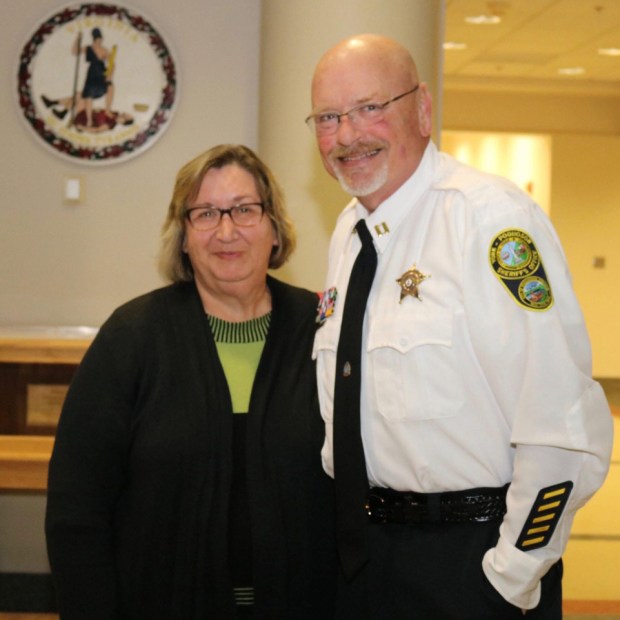
Troy Lyons, in his York-Poquoson Sheriff’s Office uniform, with his wife of more than 30 years, Cristy. (Courtesy/Troy Lyons)
In January 2025, Lyons began kidney dialysis. While the dialysis is helping him, everything in his life has to be planned around the times that he receives treatment. It’s a far cry from before his diagnosis, when he was very active. Among the things he used to love to do was travel, which he’s had to give up because of dialysis.
“I was very much into motorcycling and doing long distance motorcycle rides,” he said. “That ended because I couldn’t even hold a motorcycle up so I ended up having to get rid of it.”
Even spending a day with his 4-year-old grandson wipes him out. “My whole world has been turned upside down,” he said.
Still, even on the days that are bad, Lyons tries his best to stay positive.
“I know that I have to plow through it. I know, unless I get a kidney transplant, I’m not going to get better,” Lyons said.
To become a donor, there are multiple ways to help. Potential donors can visit kidneysforcommunities.org or sign up to begin testing through the transplant center at VCU Health in Richmond or at the Inova Fairfax Medical Campus in northern Virginia. Kidneys for Communities is available for help by emailing info@kidneysforcommunities.org.
Without a transplant, Lyons’ mortality is at best another 5-10 years. So receiving a donation would literally be a life changer, he said.
“After the recovery time from receiving a kidney donation, if the kidney functions as advertised, my life can start returning back to normal,” he said. “My strength will start to come back, my stamina will start to come back, and I’ll be able to do things that I did before that I can’t do now.”