Daniel retired 11 years ago, after serving for 31 years as a law enforcement ranger all over the US. After receiving a stage 5 kidney failure diagnosis he has had to put his retirement activities on hold.
About Daniel Brown
Daniel Brown spent 31 years keeping visitors to our National Parks safe, as a Ranger in the law enforcement unit of the National Park Service.
He spent the bulk of his service stationed at the Statue of Liberty, but he also served details at dozens of other parks ranging from Acadia up in Maine to Mount Rushmore in South Dakota and down to the Grand Canyon. When he retired 11 years ago, Daniel was “Lady Liberty’s” Chief Ranger of Law Enforcement.
After graduating from the State University of New York at Westbury, where he majored in math and biology, his career path took a turn. He had planned to go to medical school, but he needed a job. So he began working as a Park Ranger at Hamilton Grange National Memorial, Alexander Hamilton’s home in upper Manhattan.
While guarding our nation’s treasures, Daniel married and raised a family. He and Nina, who was a police officer in Brooklyn, have three sons and four grandchildren. Daniel enjoys photography and traveling, and he also spent time working with youth, coaching basketball and serving as a referee at games throughout his home town of Staten Island and in Manhattan and the Bronx.
He had planned to continue these activities as he continued in retirement, but health issues got in the way. About five years ago, he was diagnosed with hypertension. He now admits he didn’t comprehend the severity, and he failed to stay on top of his medications. The illness progressed and last year, with Stage 5 kidney failure, he went onto dialysis three times a week.
Daniel is eager to get his life back – especially coaching youth basketball. A living kidney donor can help him realize that dream.
Do you want to help Daniel? Please share the link to Daniel’s story or reach out to Kidneys for Communities at info@kidneysforcommunities.org to learn more about how you can help. The Kidneys for Communities team is here to answer your questions.
KIDNEY DONATION
How does kidney donation work?
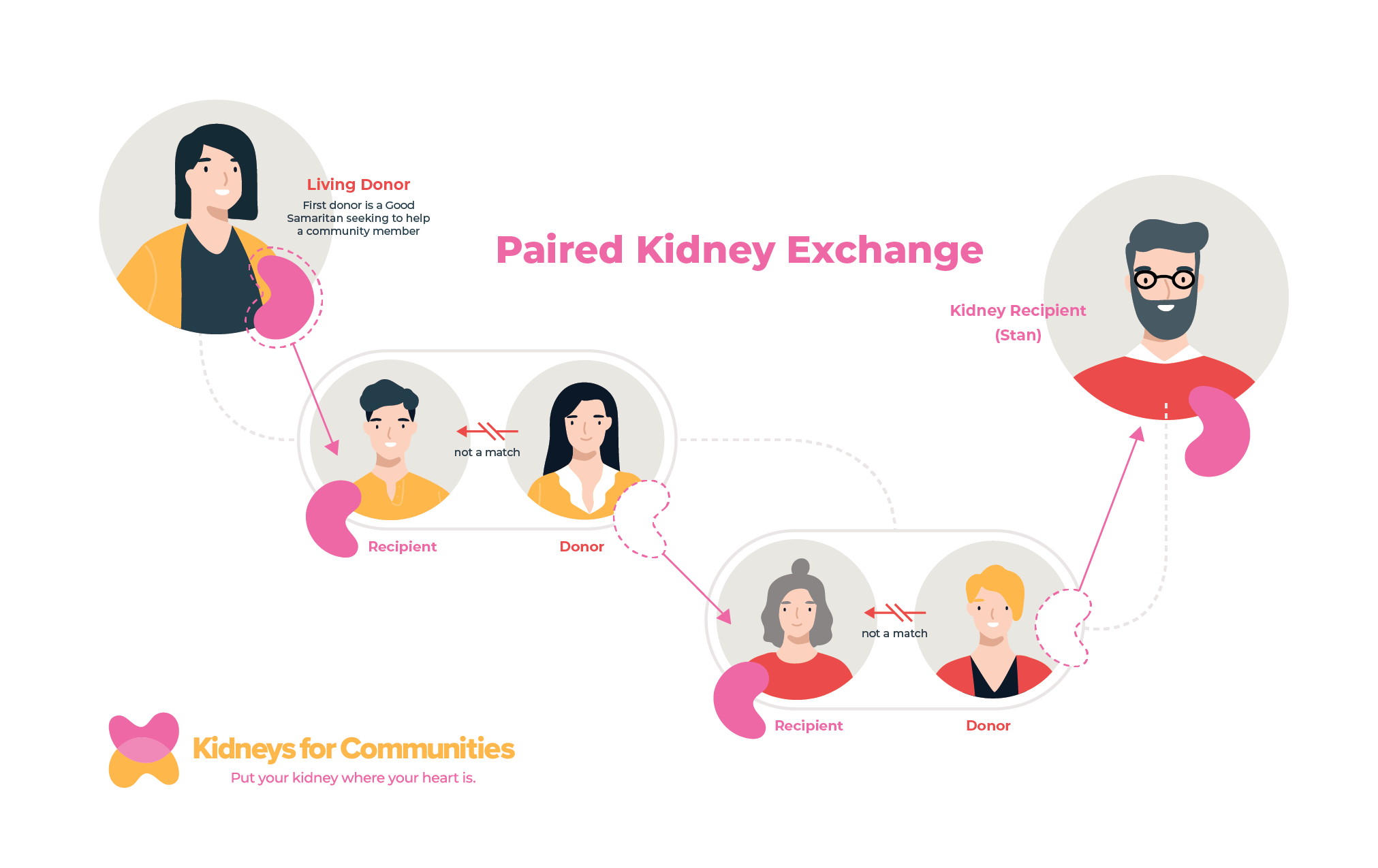
A donor doesn’t need to be an exact match. In fact, because of the Nobel Prize-winning paired kidney exchange program, your kidney donation will not only save one life, but it will save several more in the chain.
Living kidney donation is safe, and all costs associated with your donation are covered. Living donor kidneys also last much longer than deceased donor kidneys. A deceased donor kidney transplant, on average, lasts 10-15 years, while a living donor transplant lasts 12-20 years.
Kidneys for Communities® Donor Benefits
Donating a kidney is one of the most rewarding and fulfilling acts someone can do.
Kidneys for Communities can help you through the process to help save a life, but we know there are many obstacles that can be prohibitive to the donor. At Kidneys for Communities, we take care of our donors with the industry’s most complete donor benefits package:
Onboarding and education
Personalized guidance through the donation process
Anonymity
Cost reimbursements:
Travel, food & lodging, lost wages, child, pet and adult care