Clinton, a Police Officer in New Canaan , CT, is looking for hope: Hope for better health, more energy, a future with his kids, his fiancé, coaching girls basketball, and getting back to being the Police Officer he loves being.
About Clinton Jarvis
Being a police officer was always Clinton Jarvis’ dream job, since he saw the first “Beverly Hill Cop” movie when he was nine. He is now in his 16th year of serving the people of Connecticut, five years with the police department in his hometown of Bridgeport, and currently as an officer with the New Canaan Police.
In his mid-thirties, an emergency room visit for an unrelated issue changed his life forever. He was diagnosed with Polycystic Kidney Disease (PKD), a hereditary disease that runs in his family. Clinton’s father, uncles and grandfather have all endured dialysis and, ultimately, all received kidney transplants. “Knowing my family's history,” he said, “I understand what could lie ahead, but nothing truly prepares you for living it yourself.”
Clinton’s kidney function is now at 12%, and the disease affects nearly every aspect of his daily life. He battles severe headaches, overwhelming fatigue, high blood pressure, and constant discomfort caused by the enlarged kidneys outgrowing their space at an alarming rate due to the growing cyst that PKD leaves behind. Even deploying every day with all his heavy gear has become a tiring chore.
He continues to enjoy the things that matter most, as the devoted father of a 14-yr old daughter and 13-yr old son, with a loving fiancé. He’s a proud dog dad, an avid Philadelphia Eagles fan, and a he loves hiking, traveling and spending time with his family. He’s coached elementary school girls' basketball for the last four years and would like to continue. “These are the moments that bring me joy,” he says, “but as PKD progresses, it’s become increasingly difficult to enjoy life way I once did.”
A living kidney transplant represents hope for Clinton --hope for better health, hope for more energy, hope for a future where he can again enjoy coaching and patrolling without feeling exhausted, hiking the trails he loves, spending time with his children, marrying the “love of my life,” and simply completing everyday tasks without having to stop because his body won't let him.
A living kidney donor can turn Clinton’s hopes into reality.
Do you want to help Clinton? Please share the link to Clinton’s story or reach out to Kidneys for Communities at info@kidneysforcommunities.org to learn more about how you can help. The Kidneys for Communities team is here to answer your questions.
How you can help
The process starts with a simple online questionnaire, followed by a phone interview with a transplant coordinator, both of which are completely confidential.
Please also share this website with everyone in your social channels and others who may be interested in helping us out.
KIDNEY DONATION
How does kidney donation work?
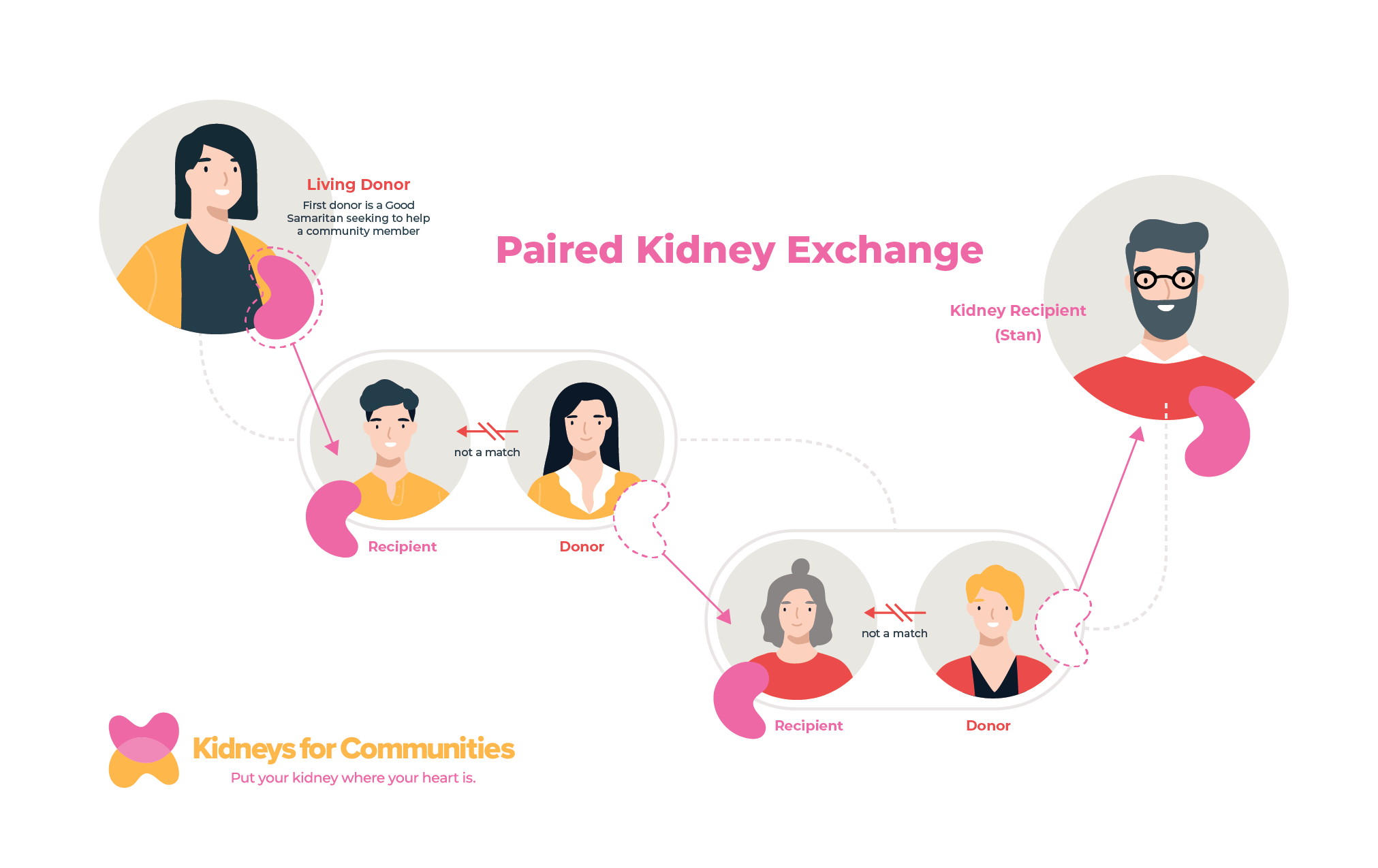
A donor doesn’t need to be an exact match. In fact, because of the Nobel Prize-winning paired kidney exchange program, your kidney donation will not only save one life, but it will save several more in the chain.
Living kidney donation is safe, and all costs associated with your donation are covered. Living donor kidneys also last much longer than deceased donor kidneys. A deceased donor kidney transplant, on average, lasts 10-15 years, while a living donor transplant lasts 12-20 years.
Kidneys for Communities® Donor Benefits
Donating a kidney is one of the most rewarding and fulfilling acts someone can do.
Kidneys for Communities can help you through the process to help save a life, but we know there are many obstacles that can be prohibitive to the donor. At Kidneys for Communities, we take care of our donors with the industry’s most complete donor benefits package:
Onboarding and education
Personalized guidance through the donation process
Anonymity
Cost reimbursements:
Travel, food & lodging, lost wages, child, pet and adult care