Robert retired from the FDNY in 2013 after an impressive 30 years of service, including 20 years in New York. Robert is looking for his own hero now.
About Robert Menig
Ever since he was a kid, Robert Menig dreamed of being a firefighter in New York City. Even though his dad and older brother were both with the NYPD, Robert always had his heart set on becoming one of “New York’s Bravest.”
His journey to the FDNY took some twists and turns. After graduating high school in Garden City, Long Island, he moved to Tucson with his family. There, he trained and joined the Rural Metro Fire Department, serving for ten years. But in 1993, he made his way back to New York City.
Robert still had his sights set on becoming a NYC firefighter, but the waiting list was long. So, he took a different path and joined the NYPD, spending three years as a beat cop in Manhattan’s Midtown North precinct.
Finally, the day came when he got the call he’d been waiting for, and he became a New York City firefighter, mostly serving with Ladder 35 on Manhattan’s west side.
On September 11, 2001, he had to leave his shift early for personal reasons. Tragically, everyone in his house that day was killed—except for Robert.
After that, he dedicated seven months to Ground Zero, first doing search and rescue and then helping with the tough recovery efforts.
Robert retired from the FDNY in 2013 after an impressive 30 years of service, including 20 years in New York. He then moved back to Tucson and embraced the retiree lifestyle, mostly enjoying the great outdoors.
However, in July 2025, he found himself in the hospital dealing with high blood pressure. The doctors delivered some tough news: he had nephropathy and his kidneys were failing. Now, his kidney function is down to about 15 percent, and dialysis is on the horizon.
Robert longs to get back to that carefree retiree life, instead of facing the challenges of kidney failure. After spending decades helping others, he’s hoping someone might step up to help and answer his call by considering a living kidney donation.
Do you want to help Robert? Please share the link to Robert’s story or reach out to Kidneys for Communities at info@kidneysforcommunities.org to learn more about how you can help. The Kidneys for Communities team is here to answer your questions.
How you can help
The process starts with a simple online questionnaire, followed by a phone interview with a transplant coordinator, both of which are completely confidential.
Please also share this website with everyone in your social channels and others who may be interested in helping us out.
KIDNEY DONATION
How does kidney donation work?
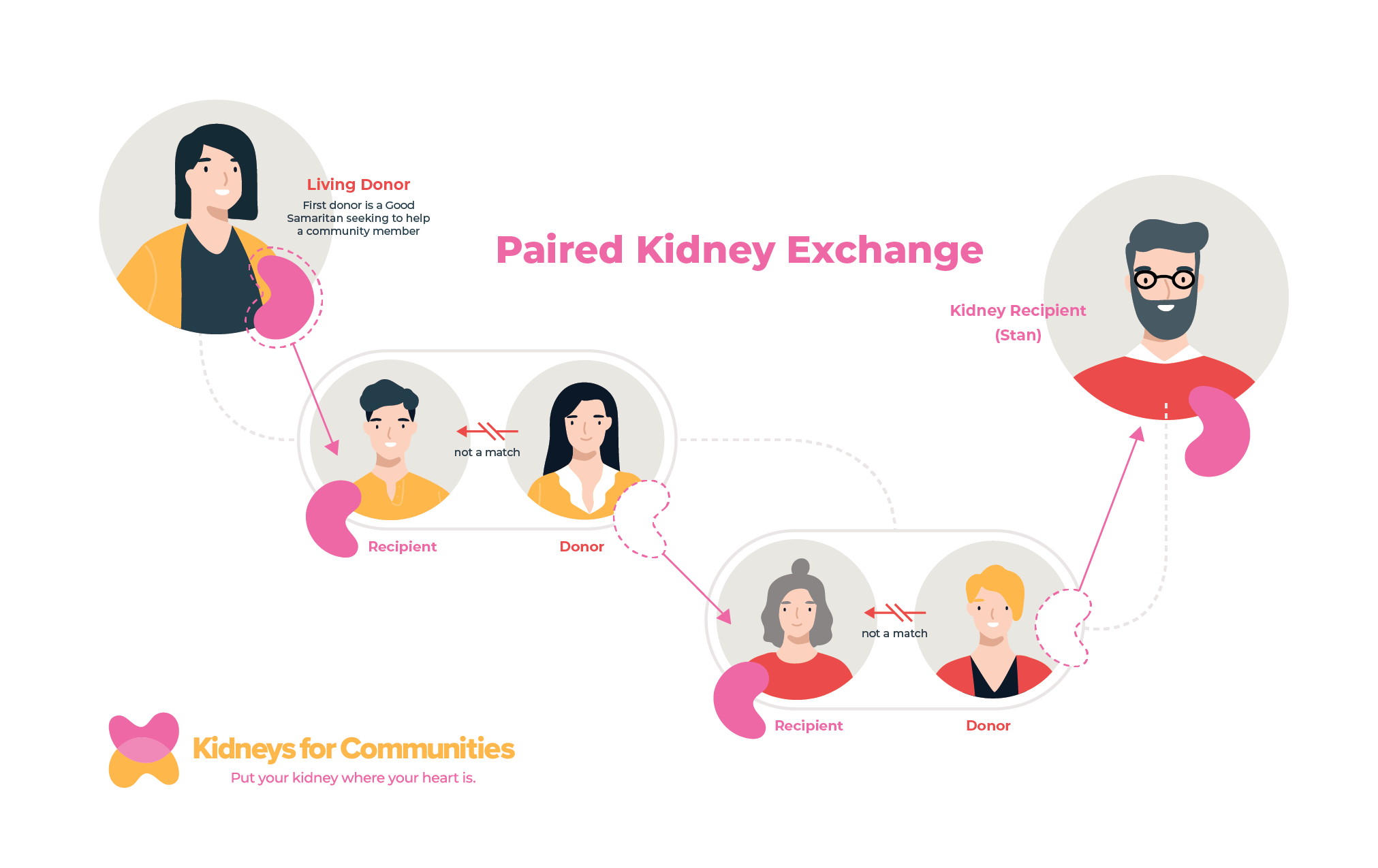
A donor doesn’t need to be an exact match. In fact, because of the Nobel Prize-winning paired kidney exchange program, your kidney donation will not only save one life, but it will save several more in the chain.
Living kidney donation is safe, and all costs associated with your donation are covered. Living donor kidneys also last much longer than deceased donor kidneys. A deceased donor kidney transplant, on average, lasts 10-15 years, while a living donor transplant lasts 12-20 years.
Kidneys for Communities® Donor Benefits
Donating a kidney is one of the most rewarding and fulfilling acts someone can do.
Kidneys for Communities can help you through the process to help save a life, but we know there are many obstacles that can be prohibitive to the donor. At Kidneys for Communities, we take care of our donors with the industry’s most complete donor benefits package:
Onboarding and education
Personalized guidance through the donation process
Anonymity
Cost reimbursements:
Travel, food & lodging, lost wages, child, pet and adult care