Derek Williams has spent most of his adult life serving the people of his hometown in Mount Vernon, a New York suburb.
About Derek Williams
A veteran Police Officer, and an Emergency Response team member, Derek is looking for his own hero now.
In 2006, six years after graduating Mount Vernon High School and working in his father’s business, he joined the Mount Vernon Police Department. After five years on the job, he joined the department’s Emergency Services Unit, where he handled all sorts of emergency responses including SWAT calls.
During the pandemic, some of his fellow officers got sick or opted out, but Derek remained active, often working double and triple shifts. “I felt the need to help my community and my department, to help fill the coverage gap,” Derek said.
Part of his work during the height of Covid included bringing sick people, and sometimes those who had succumbed to the virus, to the ER or the morgue. The department provided protective gear, but only a limited number of masks. “We improvised, using towels and bandanas to cover our faces,” he recalls.
Derek soon came down with a bad case of Covid, but since he’d seen the chaos in the ER, he toughed it out rather than go to the hospital. The damage was done, however, and he grew weaker and weaker. He ended up bed-ridden and on medical leave, and he began dialysis treatments in 2023.
Derek regained strength after he went on dialysis, and his doctor cleared him to return to work on a part-time basis. The Police Commissioner, however, said he could only return full-time and subsequently sent him a letter of termination. Derek was less than three years from being able to retire on full pension.
News of Derek’s predicament caught the attention of a local TV reporter, and the story broke locally and eventually went national. Under pressure from media attention and community uproar, the city’s mayor gave Derek a six-month extension.
Six months have passed and as of April 10, 2026, Derek is no longer on the Mount Vernon PD payroll.
He would like to return to an active life, including cooking, watching sports and caring for his four cats. His 0+ blood type makes it challenging to find a kidney match, but he is hoping a living donor will step up and help him return to a healthy and full life.
Do you want to help Derek? Please share the link to Derek’s story or reach out to Kidneys for Communities at info@kidneysforcommunities.org to learn more about how you can help. The Kidneys for Communities team is here to answer your questions.
KIDNEY DONATION
How does kidney donation work?
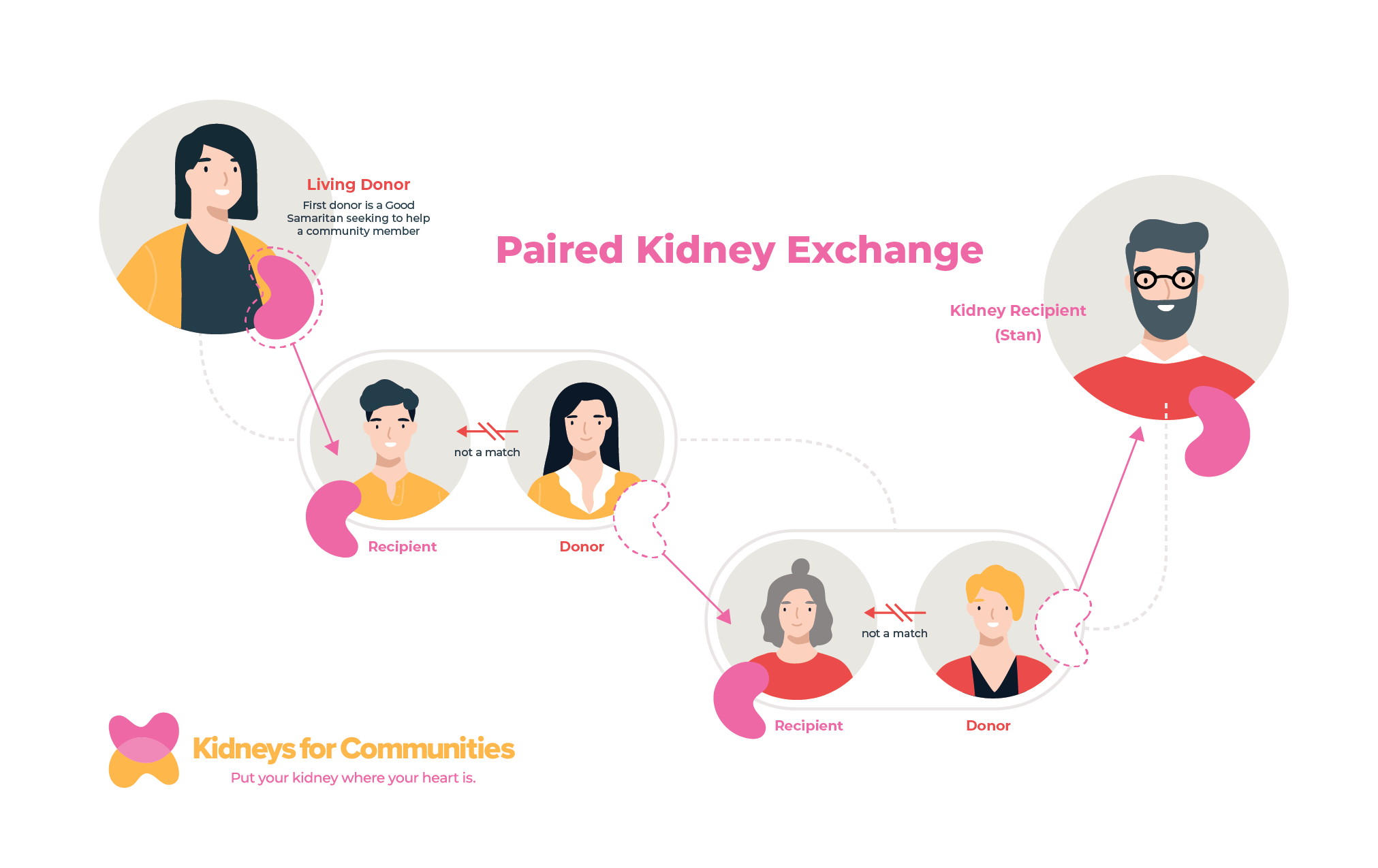
A donor doesn’t need to be an exact match. In fact, because of the Nobel Prize-winning paired kidney exchange program, your kidney donation will not only save one life, but it will save several more in the chain.
Living kidney donation is safe, and all costs associated with your donation are covered. Living donor kidneys also last much longer than deceased donor kidneys. A deceased donor kidney transplant, on average, lasts 10-15 years, while a living donor transplant lasts 12-20 years.
Kidneys for Communities® Donor Benefits
Donating a kidney is one of the most rewarding and fulfilling acts someone can do.
Kidneys for Communities can help you through the process to help save a life, but we know there are many obstacles that can be prohibitive to the donor. At Kidneys for Communities, we take care of our donors with the industry’s most complete donor benefits package:
Onboarding and education
Personalized guidance through the donation process
Anonymity
Cost reimbursements:
Travel, food & lodging, lost wages, child, pet and adult care